Neuroprotection, BDNF & Cognitive Research
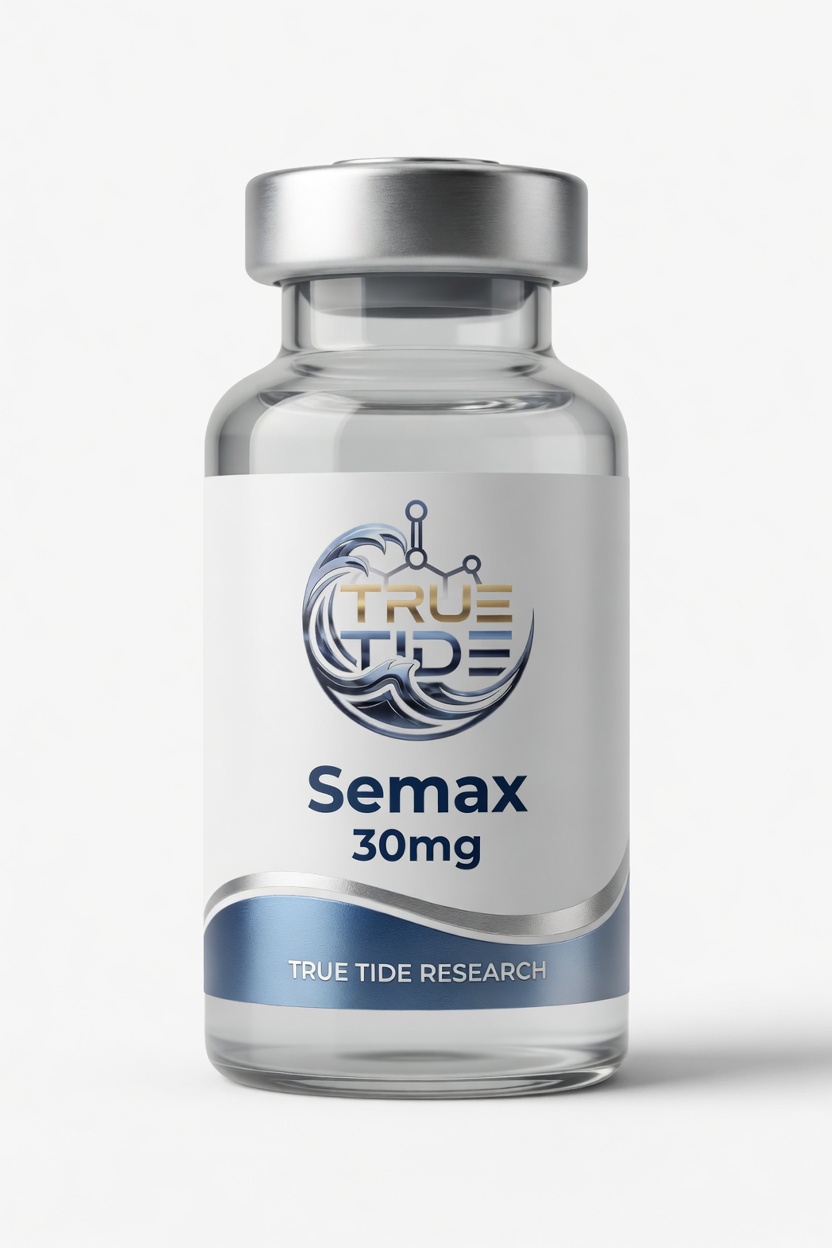
Semax is a synthetic heptapeptide (Met-Glu-His-Phe-Pro-Gly-Pro) derived from the ACTH(4-7) sequence with a C-terminal Pro-Gly-Pro extension that enhances stability and bioavailability. Developed at the Institute of Molecular Genetics in Moscow, Semax has been approved as a drug in Russia and Ukraine. Research documents strong neuroprotective activity, BDNF and NGF upregulation, serotonin and dopamine system modulation, and cognitive-enhancing properties in pre-clinical models.
Semax (Met-Glu-His-Phe-Pro-Gly-Pro) is a synthetic analogue of the ACTH(4-7) fragment, modified with a C-terminal Pro-Gly-Pro sequence to enhance stability and activity. Unlike ACTH itself, Semax has no corticotropic activity (no effect on the adrenal gland), but retains and amplifies the melanocortinergic receptor-independent CNS effects of the ACTH fragment.
The peptide has been the subject of over 100 studies since its development in the 1980s. It is registered as a medical drug in Russia under the trade name Semax for the treatment of stroke, transient ischaemic attacks, and peptic ulcers. Research in the West has focused on its nootropic, neuroprotective, and anxiolytic properties.
The most extensively studied mechanism of Semax is its upregulation of brain-derived neurotrophic factor (BDNF) and nerve growth factor (NGF). BDNF is critical to neuronal survival, synaptic plasticity, and neurogenesis. Multiple studies demonstrate that Semax significantly increases BDNF gene expression and protein levels in cortical and hippocampal tissue, effects that persist for several days after administration.
Semax modulates serotonergic and dopaminergic signalling in the brain. Research indicates increased serotonin turnover in specific brain regions, as well as upregulation of dopamine D2 receptors. These mechanisms are proposed to underlie both the anxiolytic and cognitive-enhancing effects observed in pre-clinical models.
In ischaemic injury models, Semax reduces infarct size, preserves neuronal viability, and promotes functional recovery. Proposed mechanisms include reduction of oxidative stress, anti-inflammatory cytokine modulation (IL-6, TNF-α reduction), and anti-apoptotic signalling through caspase pathway inhibition.
Semax modulates brain nitric oxide synthase (NOS) activity, which plays roles in both neuroprotection and cognitive function. The NO signalling interaction may contribute to improvements in cerebral blood flow observed in stroke research models.
Dolotov OV et al. demonstrated that intranasal Semax administration produced significant increases in BDNF and NGF mRNA and protein levels in rat cortex and hippocampus. The upregulation persisted for 24 hours post-administration and was dose-dependent.
Gusev EI et al. conducted a clinical study in acute ischaemic stroke patients showing that intranasal Semax treatment (12-20 days post-stroke) significantly reduced neurological deficit scores compared to placebo and was associated with better long-term functional outcomes.
Mironova VI et al. showed that Semax significantly reduced neuronal death in a rodent TBI model, preserved cognitive function in post-injury testing, and reduced markers of oxidative damage and neuroinflammation. BDNF upregulation was proposed as a key protective mechanism.
Agapova TY et al. investigated the monoaminergic effects of Semax, demonstrating significant increases in dopamine D2 receptor density and serotonin turnover in prefrontal cortex and limbic regions of treated rats, consistent with anxiolytic and procognitive mechanisms.
Semax is commonly reconstituted with sterile saline or bacteriostatic water. A notable characteristic of Semax in research is its suitability for intranasal administration (due to its small size and CNS penetrance via the olfactory route), as well as subcutaneous injection in animal models.
Rodent studies have used doses of 25–300 mcg/kg via subcutaneous injection or intranasal instillation. Human clinical trials in Russia used 12-22 drops of a 0.1% nasal solution per day. These are for scientific reference only.
| Product Name | Semax |
| CAS Number | 80714-61-0 |
| Molecular Formula | C₃₇H₅₁N₉O₁₀S |
| Molecular Weight | 813.9 Da |
| Sequence | Met-Glu-His-Phe-Pro-Gly-Pro |
| Appearance | White lyophilized powder |
| Purity | ≥99% (HPLC) |
| Storage (lyophilized) | −20°C, protected from light |
| Storage (reconstituted) | 2–8°C, use within 30 days |
| COA | Available with each order |