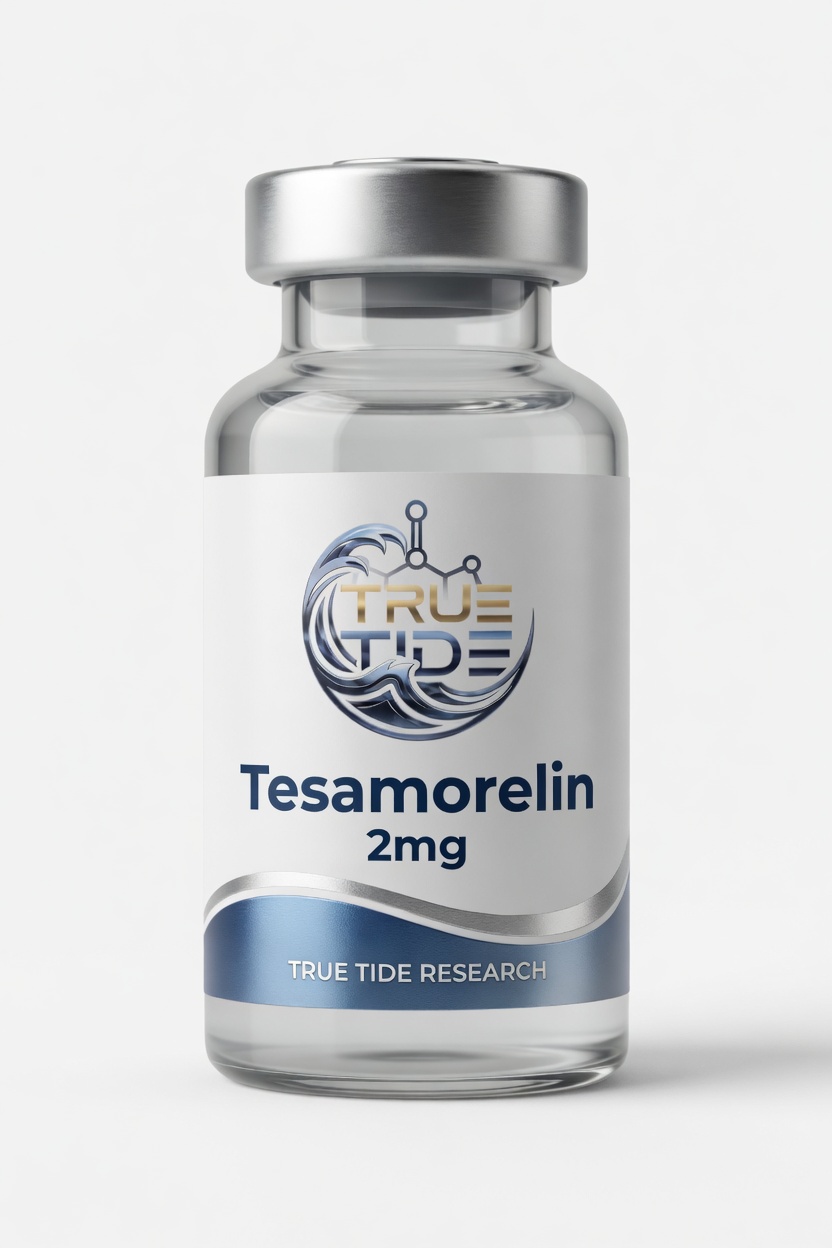
Tesamorelin is a synthetic analogue of human GHRH consisting of the full 44 amino acid GHRH sequence with a trans-3-hexenoic acid group. It is FDA-approved (as Egrifta) for HIV-associated lipodystrophy and has Phase 3 clinical trial data for visceral fat reduction. As a research compound, it serves as the gold-standard GHRH reference with the most robust clinical dataset of any GHRH analogue.
CAS 901758-09-6 | MW 5135.9 DaFull-length GHRH analogue that binds the pituitary GHRH receptor with high affinity, triggering pulsatile GH secretion.
Phase 3 data demonstrates significant reduction in visceral adipose tissue (VAT) via GH-mediated lipolysis — a key metabolic research endpoint.
Sustained GHRH stimulation normalizes GH secretion and downstream IGF-1 in GH-deficient models.
Unlike exogenous GH, tesamorelin preserves physiological GH feedback and does not cause the blunted negative feedback seen with direct GH administration.
Falutz et al. (2010) demonstrated that tesamorelin 2mg/day for 26 weeks reduced visceral adipose tissue by 15.2% vs placebo in HIV lipodystrophy, leading to FDA approval.
N Engl J Med. 2010;363(8):724–736Baker et al. found 20 weeks of tesamorelin improved verbal memory and executive function in older adults, suggesting GH axis role in cognitive aging.
JAMA Intern Med. 2012;172(18):1406–1413Stanley et al. showed tesamorelin reduced liver fat in HIV-associated NAFLD, demonstrating utility in hepatic metabolic research.
Lancet HIV. 2014;1(1):e27–35FDA-approved clinical dose: 2mg SC once daily. Research protocols in non-HIV models have examined 1–4mg/day ranges. Combination studies with GHRPs (ipamorelin, GHRP-2) use reduced tesamorelin doses. GH, IGF-1, VAT measurement, and glucose tolerance are standard endpoints.
| Full Name | Tesamorelin Acetate |
| CAS Number | 901758-09-6 |
| Molecular Weight | 5135.9 Da |
| Amino Acids | 44 |
| Modification | Trans-3-hexenoic acid conjugate |
| Purity | ≥99% by HPLC |
| Appearance | White lyophilized powder |
| Storage | −20°C, desiccated |