Growth Hormone Releasing Hormone Analogue Research
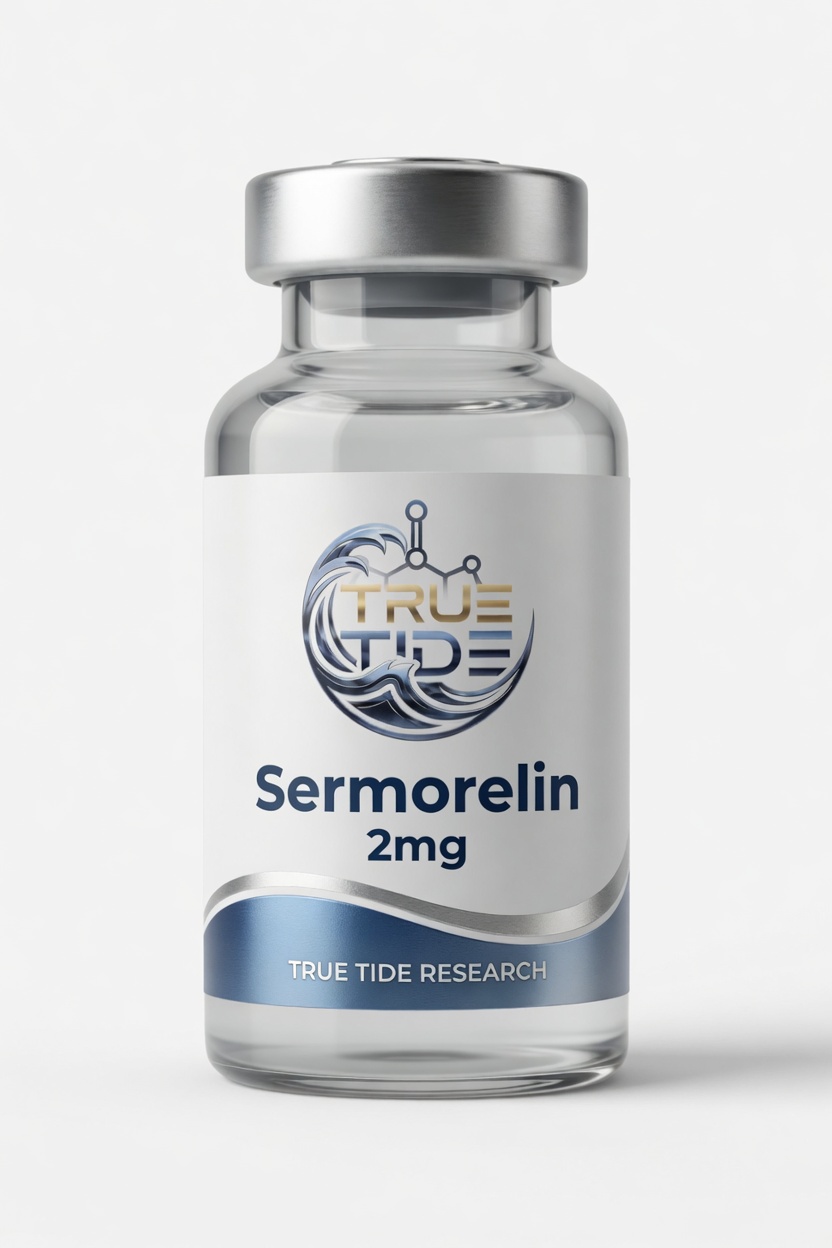
Sermorelin acetate is a synthetic peptide comprising the first 29 amino acids of endogenous growth hormone-releasing hormone (GHRH). It acts directly on pituitary somatotroph cells to stimulate pulsatile release of growth hormone. Research interest spans GH deficiency models, body composition, sleep architecture, IGF-1 axis modulation, and anti-aging biology.
Sermorelin (also called GHRH(1-29)-NH₂) is a synthetic truncated analogue of growth hormone-releasing hormone, containing the first 29 of the 44 amino acids of the naturally occurring GHRH. This 29-amino acid sequence retains the full biological activity of endogenous GHRH, binding to pituitary GHRH receptors and stimulating the synthesis and pulsatile secretion of growth hormone.
Unlike direct GH administration, sermorelin preserves the natural pulsatile pattern of GH release and is subject to normal feedback regulation, including somatostatin-mediated inhibition. This physiological quality of action is a key reason researchers study it as a model for GH axis investigation.
Sermorelin binds with high affinity to pituitary GHRH receptors (GHRHR), a Gs-protein coupled receptor. This binding activates adenylyl cyclase, increasing intracellular cAMP levels, which in turn activates protein kinase A and leads to calcium mobilisation, ultimately triggering the release of stored GH from somatotroph secretory granules.
Sermorelin preserves the natural pulsatile pattern of GH release, maintaining feedback loop integrity through somatostatin-mediated regulation. This contrasts with exogenous GH administration, which suppresses endogenous GH production. Research models using sermorelin therefore maintain the intact GH axis while stimulating its activity.
GH released in response to sermorelin stimulates hepatic production of insulin-like growth factor 1 (IGF-1), which mediates many of GH's anabolic and tissue-repair effects. Studies show sermorelin treatment increases circulating IGF-1 levels proportionally to the GH response, allowing investigation of the full GH-IGF-1 axis.
Thorner MO et al. demonstrated that twice-daily sermorelin administration to GH-deficient adults produced significant increases in GH pulse amplitude and circulating IGF-1 levels, with improvements in body composition (reduced fat mass, increased lean mass) after 6 months of treatment in this controlled study.
Marshall L et al. showed that intravenous GHRH(1-29) administration significantly increased slow-wave sleep duration and GH secretion during sleep in healthy adults. The study established a mechanistic link between the GH axis and sleep architecture regulation.
Khorram O et al. compared sermorelin to direct GH administration in older adults, finding comparable improvements in lean body mass, bone density, and skin thickness, while sermorelin maintained superior GH axis physiology with preserved pulsatility and feedback regulation.
Vitiello MV et al. reported that GHRH administration improved cognitive performance, working memory, and mood measures in older adults compared to placebo in a randomised controlled trial, suggesting neurotrophic roles beyond the classical GH axis.
Sermorelin lyophilized powder is reconstituted with bacteriostatic water. Standard reconstitution of 5mg uses 2.5ml BAC water to create a 2 mg/ml solution. Reconstituted peptide should be stored at 2–8°C and used within 28 days. Protect from light and avoid freezing reconstituted solution.
Human clinical trial doses have ranged from 0.5–1.0 mcg/kg administered subcutaneously, typically in the evening to align with natural GH pulsatility patterns. Rodent studies use weight-based dosing of 1–10 mcg/kg. These are for scientific reference only.
| Product Name | Sermorelin Acetate (GHRH 1-29) |
| CAS Number | 86168-78-7 |
| Molecular Formula | C₁₄₉H₂₄₆N₄₄O₄₂S |
| Molecular Weight | 3,358.0 Da |
| Sequence | Tyr-Ala-Asp-Ala-Ile-Phe-Thr-Asn-Ser-Tyr-Arg-Lys-Val-Leu-Gly-Gln-Leu-Ser-Ala-Arg-Lys-Leu-Leu-Gln-Asp-Ile-Met-Ser-Arg-NH₂ |
| Appearance | White lyophilized powder |
| Purity | ≥99% (HPLC) |
| Storage (lyophilized) | −20°C, protected from light |
| Storage (reconstituted) | 2–8°C, use within 28 days |
| COA | Available with each order |