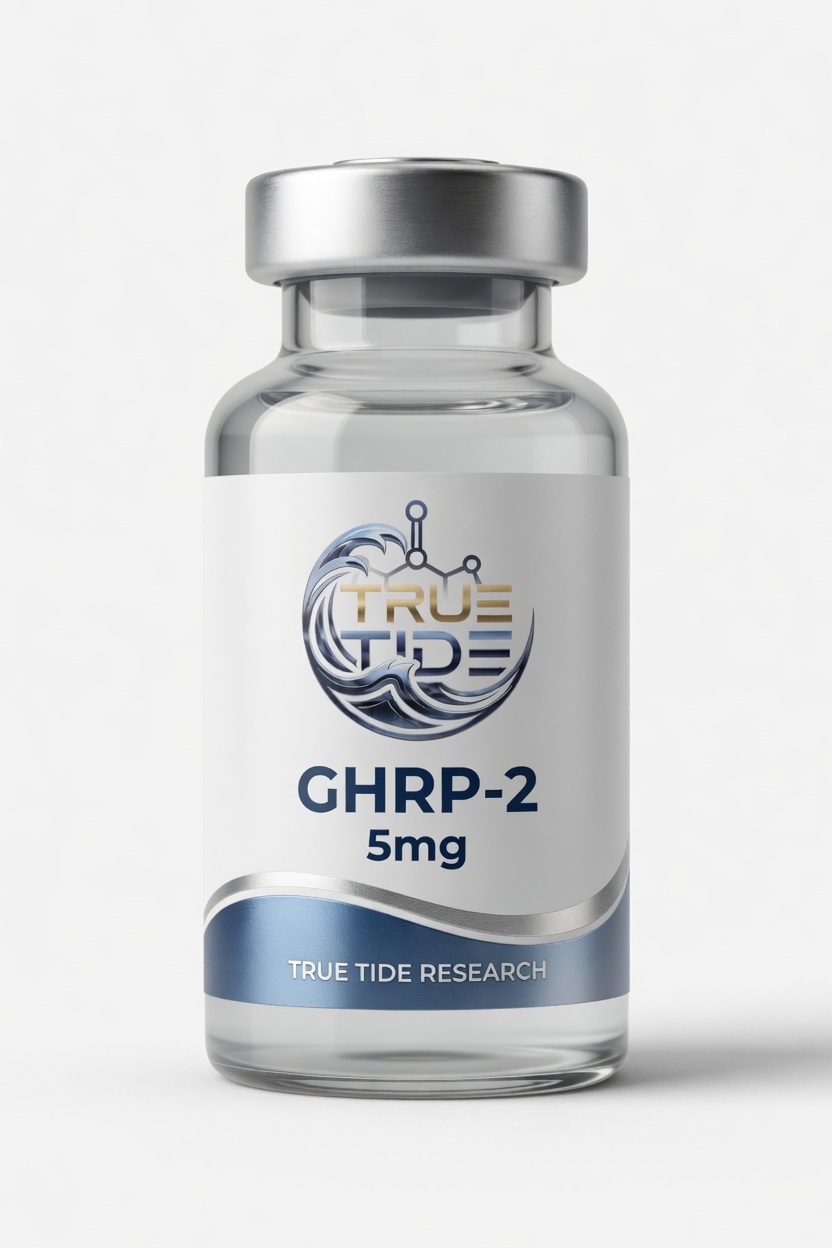
GHRP-2 (Pralmorelin) is a synthetic hexapeptide (D-Ala-D-β-Nal-Ala-Trp-D-Phe-Lys-NH₂) that stimulates GH release by acting at both pituitary GHS-R and hypothalamic GHRH neurons. It produces strong GH pulses but also elevates cortisol and prolactin at higher doses — making it a valuable reference compound versus selective GHRPs in comparative research.
CAS 158861-67-7 | MW 817.9 DaAmong the most potent synthetic GHS-R1a agonists. Produces robust, dose-dependent GH release in rodents and primates.
Unlike ipamorelin, GHRP-2 activates the HPA axis, elevating cortisol and ACTH — a key research variable.
Acts through the endogenous ghrelin receptor pathway, increasing appetite signalling as a measurable endpoint.
Consistent GH elevation leads to downstream IGF-1 production, supporting research into the GH/IGF-1 axis.
Takahashi et al. demonstrated GHRP-2 to be superior to GHRH alone for stimulating GH in GH-deficient adults, with 97% specificity at established cut-off thresholds.
Endocr J. 2012;59(4):285–296Massoud et al. showed that combining GHRP-2 with GHRH produced a synergistic GH response 3–4× greater than either peptide alone.
J Clin Endocrinol Metab. 1996;81(7):2596–2602Prolonged GHRP-2 administration in GH-deficient rodents normalized IGF-1 levels and partially reversed bone and lean mass deficits.
Growth Horm IGF Res. 2003;13(2):93–99Rodent studies use 100–300 µg/kg SC. In human clinical research (GH stimulation tests), 1 µg/kg IV has been the standard dosing. Research protocols pair GHRP-2 with GHRH for maximum GH output. Cortisol and prolactin should be monitored as co-variables in studies.
| Full Name | GHRP-2 (Pralmorelin) |
| CAS Number | 158861-67-7 |
| Molecular Formula | C₄₅H₅₅N₉O₆ |
| Molecular Weight | 817.9 Da |
| Sequence | D-Ala-D-β-Nal-Ala-Trp-D-Phe-Lys-NH₂ |
| Purity | ≥99% by HPLC |
| Appearance | White lyophilized powder |
| Storage | −20°C, desiccated |