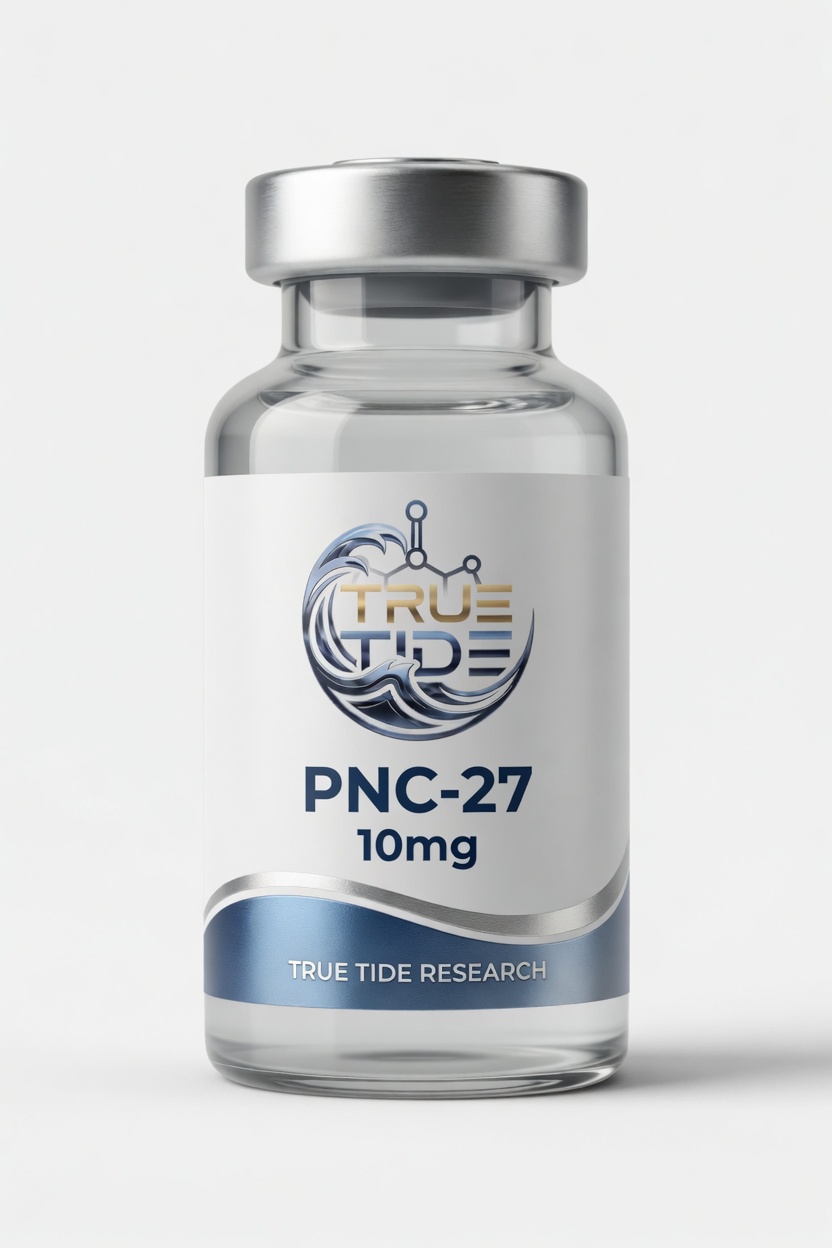
PNC-27 is a 32-amino acid peptide encompassing residues 17-26 of the p53 tumor suppressor protein's MDM-2 binding domain, fused to a cell membrane-penetrating leader sequence. It selectively interacts with HDM-2 (the human p53 homolog of MDM-2) expressed on the plasma membrane of cancer cells — a surface expression not found on normal cells. This selectivity makes PNC-27 a key research tool for cancer cell biology and targeted oncology studies.
CAS 881685-59-2 | 32 amino acids | p53 MDM-2 binding domainBinds HDM-2 (overexpressed on tumor cell membranes) forming a complex that inserts into and disrupts the plasma membrane.
HDM-2/PNC-27 complex creates transmembrane pores specifically in cancer cells, leading to rapid necrosis-like cell death.
Non-cancerous cells lack surface HDM-2 expression and are not affected — establishing the selectivity basis for PNC-27 research.
Cell death is necrotic/membrane disruption-based rather than apoptotic — important for research distinguishing p53-pathway from membrane integrity endpoints.
Bowne et al. demonstrated PNC-27 caused rapid, selective lysis of HDM-2-expressing human cancer cell lines (breast, pancreatic, leukemia) while sparing normal human mammary epithelial cells at the same concentration.
J Surg Res. 2009;163(2):260–268Weissler et al. confirmed PNC-27 killed breast cancer cells in vitro through HDM-2-mediated membrane pore formation, with cell death confirmed by FACS, LDH release, and EM ultrastructure.
Oncol Rep. 2010;23(1):69–76Administration in pancreatic tumor-bearing mice reduced tumor volume significantly vs control. Histology confirmed tumor cell necrosis without surrounding tissue damage.
Surgery. 2012;151(2):168–176In vitro studies use 50–200 µM for 24–72 hours with cancer cell lines. In vivo tumor models use 5–15 mg/kg IP or intratumoral. Endpoints: LDH release (cytotoxicity), flow cytometry (annexin V/PI), confocal microscopy (membrane integrity), tumor volume measurement (caliper/imaging), and HDM-2 expression confirmation by immunofluorescence.
| Full Name | PNC-27 |
| CAS Number | 881685-59-2 |
| Amino Acids | 32 |
| Domain | p53 residues 17-26 + leader sequence |
| Target | HDM-2 (surface-expressed) |
| Purity | ≥99% by HPLC |
| Appearance | White lyophilized powder |
| Storage | −20°C, desiccated |