Wound Healing, Skin Repair & Anti-Aging Research
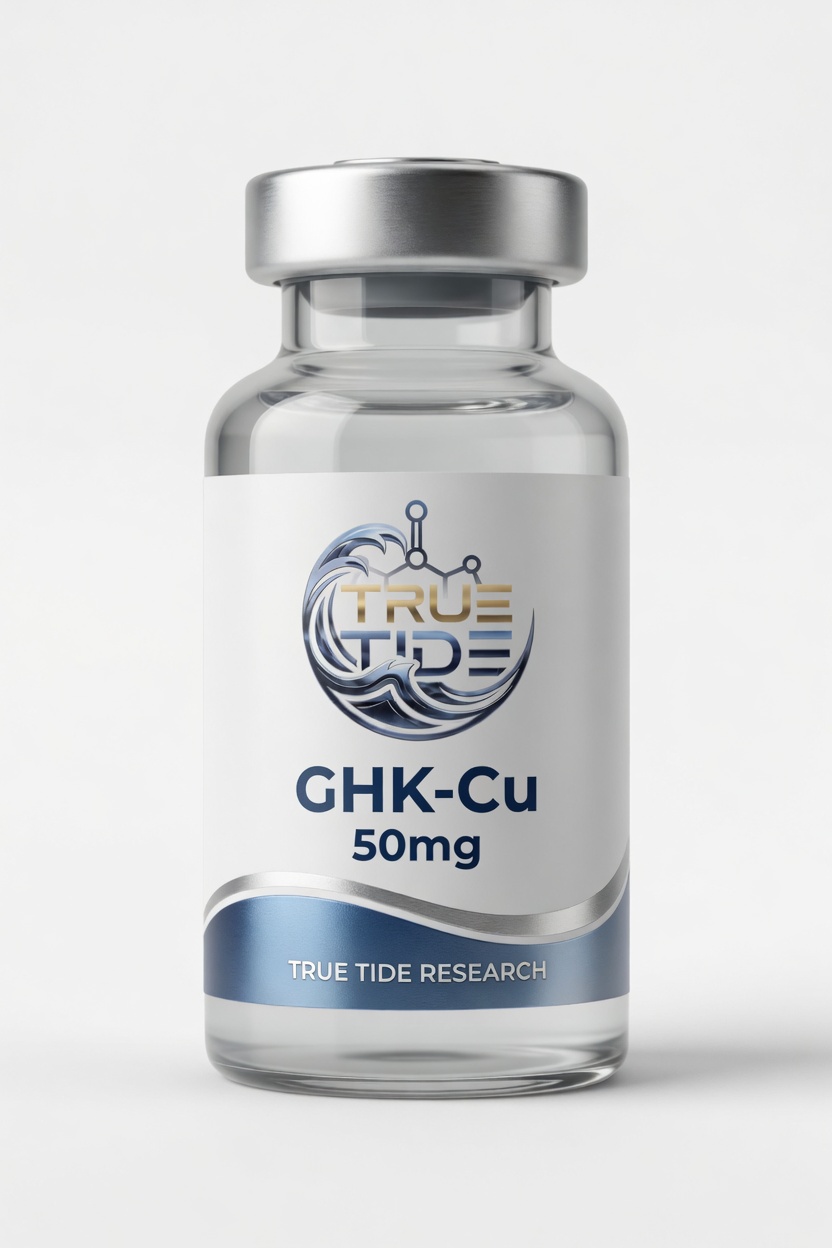
GHK-Cu is a naturally occurring copper-binding tripeptide (Gly-His-Lys·Cu²⁺) found in human plasma, saliva, and urine. It has been extensively studied for its roles in wound healing, skin repair and regeneration, stimulation of collagen and glycosaminoglycan synthesis, antioxidant activity, and anti-inflammatory modulation. Research interest has expanded into anti-aging, hair follicle stimulation, and neuroprotection.
GHK-Cu (Glycine-L-Histidine-L-Lysine complexed with copper(II)) is a tripeptide-copper complex first isolated from human plasma by Loren Pickart in 1973. It is present naturally in plasma (~200 ng/ml), saliva, and urine, with concentrations declining significantly with age. GHK-Cu acts as a biological signal for wound healing and tissue remodelling, with a remarkable range of activities documented across hundreds of studies.
The peptide stimulates the synthesis of collagen, elastin, and glycosaminoglycans in skin fibroblasts; promotes angiogenesis; modulates inflammation; and acts as a potent antioxidant by chelating free copper ions. It also activates the ubiquitin-proteasome system to remove damaged proteins.
The biological activity of GHK-Cu depends critically on its coordination of copper(II) ions. The copper is bound between the histidine imidazole nitrogen, the glycine alpha-amino group, and the deprotonated glycine amide nitrogen, forming a stable square-planar complex. This structure enables GHK-Cu to serve as both a copper transport molecule and a direct signalling molecule.
GHK-Cu activates fibroblasts to increase production of collagen I, III, and IV, elastin, and various glycosaminoglycans including dermatan sulphate and heparan sulphate. This is mediated partly through upregulation of TGF-β and activation of integrin signalling pathways, and represents the core mechanism behind its wound healing and anti-aging activities.
Research by Pickart and Margolina demonstrated that GHK-Cu modulates the expression of over 4,000 human genes — resetting many gene expressions toward a more youthful pattern. It upregulates genes associated with tissue repair and downregulates genes associated with inflammation, cancer progression, and neurodegeneration.
GHK-Cu chelates free copper ions that would otherwise catalyse oxidative reactions. Additionally, it downregulates TNF-α, IL-6, and other pro-inflammatory cytokines while promoting antioxidant enzymes including superoxide dismutase and catalase.
Pickart L et al. demonstrated that GHK-Cu significantly accelerated wound healing in multiple animal models, promoting collagen synthesis, angiogenesis, and re-epithelialisation. Fibroblast activation was identified as the primary mechanism, with treated wounds showing superior tensile strength at healing completion.
Pickart L and Margolina A conducted comprehensive gene expression analysis showing GHK-Cu modulation of 4,028 human genes. The peptide upregulated genes associated with tissue repair and stem cell function while downregulating those associated with inflammation and cancer progression.
Research by Uno H demonstrated that topical GHK-Cu application to miniaturised hair follicles increased follicle size, induced transition from telogen to anagen phase, and stimulated dermal papilla cell proliferation. Results were comparable to minoxidil in the study model.
Dou Y et al. investigated GHK-Cu's neuroprotective activity in ischaemic brain injury models. Treatment reduced infarct volume, improved neurological scores, and decreased oxidative stress markers. Anti-apoptotic effects through Bcl-2 upregulation were identified.
GHK-Cu lyophilized powder reconstitutes readily in sterile or bacteriostatic water. Due to the higher milligram amounts used in some research applications, preparing stock solutions of 1–10 mg/ml is common. Reconstituted solutions should be stored at 2–8°C and used within 30 days.
Cell culture studies have used GHK-Cu concentrations of 1 nM to 100 μM depending on the biological endpoint being studied. Lower concentrations (1–10 nM) have been used for gene expression studies, while higher concentrations (1–10 μM) are common in wound healing and collagen synthesis assays.
Animal wound healing studies have applied GHK-Cu topically in gel or solution form at concentrations of 0.1–1% by weight. Systemic administration in rodent studies has employed doses of 0.5–5 mg/kg. These figures are for scientific reference only.
| Product Name | GHK-Cu (Glycine-Histidine-Lysine Copper) |
| CAS Number | 49557-75-7 |
| Molecular Formula | C₁₄H₂₃CuN₆O₄ |
| Molecular Weight | 340.4 Da |
| Sequence | Gly-His-Lys · Cu²⁺ |
| Appearance | Blue-green lyophilized powder |
| Purity | ≥99% (HPLC) |
| Storage (lyophilized) | −20°C, protected from light |
| Storage (reconstituted) | 2–8°C, use within 30 days |
| Solubility | Water, saline, aqueous buffers |
| COA | Available with each order |