Sexual Function, Arousal & Melanocortin Research
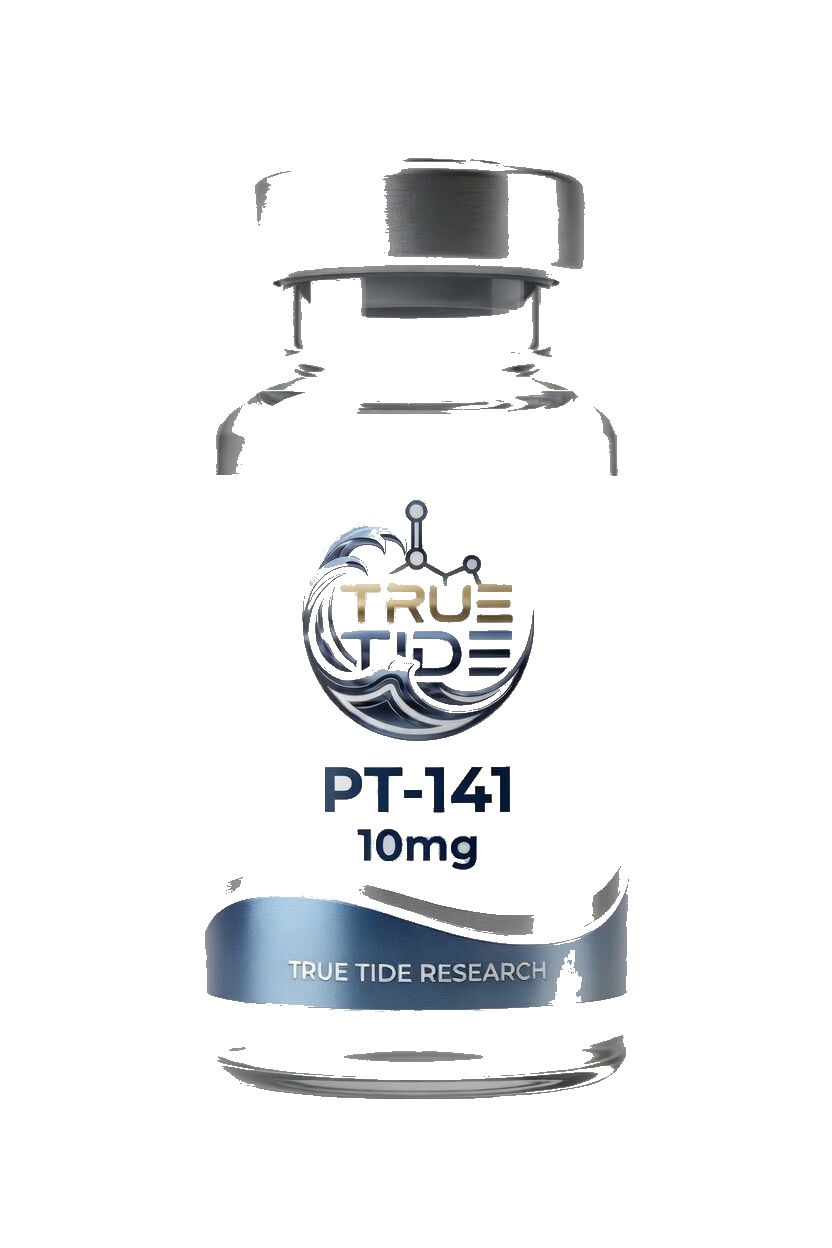
PT-141 (Bremelanotide) is a synthetic melanocortin receptor agonist derived from the peptide Melanotan II. It acts centrally through melanocortin-3 and melanocortin-4 receptors (MC3R and MC4R) in the hypothalamus to promote sexual arousal and function. A related compound (Vyleesi/bremelanotide) is FDA-approved for hypoactive sexual desire disorder in premenopausal women, making PT-141 one of the most clinically validated research peptides in the sexual health space.
PT-141 (Bremelanotide) is a cyclic heptapeptide derived from α-MSH (alpha-melanocyte-stimulating hormone) via the intermediate compound Melanotan II. Unlike phosphodiesterase inhibitors (which work peripherally via smooth muscle relaxation), PT-141 acts centrally on hypothalamic melanocortin receptors to modulate sexual desire and arousal pathways. This central mechanism of action makes it relevant to research on the neurobiology of sexual function.
The compound was originally studied for tanning (as a Melanotan II derivative) before researchers discovered its pronounced sexual arousal effects during clinical trials. Palatin Technologies developed Bremelanotide (a modified version) which received FDA approval in June 2019 as Vyleesi for female hypoactive sexual desire disorder, providing significant clinical validation.
PT-141 acts as an agonist at MC3R and MC4R receptors in the hypothalamus, particularly in the medial preoptic area (MPOA) — a key neural region for sexual behaviour regulation. Unlike peripherally acting agents, PT-141's CNS mechanism activates downstream dopaminergic and oxytocin pathways that directly modulate sexual motivation and arousal, independent of vascular effects.
MC4R activation in the hypothalamus stimulates dopamine release in limbic reward areas including the nucleus accumbens, producing motivational salience toward sexual stimuli. This mechanism explains PT-141's ability to enhance sexual desire (not just physiological arousal) — addressing the psychological component of sexual dysfunction that peripheral vasodilators cannot affect.
MC4R is also a key regulator of energy balance and appetite. PT-141's MC4R agonism has revealed important research on the relationship between energy homeostasis pathways and sexual behaviour, and has implications for metabolic disease research where MC4R mutations cause both obesity and reproductive dysfunction.
Wessells H et al. demonstrated that subcutaneous PT-141 (bremelanotide) produced penile erections in men with and without erectile dysfunction through a mechanism distinct from sildenafil. The study confirmed central nervous system (not vascular) action and dose-dependent response.
Diamond LE et al. conducted a clinical study showing that intranasal bremelanotide significantly improved sexual arousal and satisfaction scores in premenopausal women with female sexual arousal disorder. Central activation of hypothalamic sexual behaviour circuits was proposed as the mechanism.
Research demonstrated that PT-141 produced significant erectile responses in men who were non-responders to sildenafil (PDE5 inhibitors), confirming that the central melanocortin mechanism is functionally independent of the peripheral nitric oxide/cGMP pathway. This is particularly relevant for research into treatment-resistant erectile dysfunction models.
In June 2019, the FDA approved bremelanotide (Vyleesi) for hypoactive sexual desire disorder (HSDD) in premenopausal women, based on two Phase 3 clinical trials showing significant improvements in desire and distress scores versus placebo. This represents the most significant regulatory validation of the PT-141 compound class.
PT-141 lyophilized powder reconstitutes in bacteriostatic water. A 10mg vial reconstituted in 2ml BAC water gives a 5 mg/ml working solution. Store reconstituted solution at 2–8°C and use within 30 days.
Clinical trials used bremelanotide at doses of 0.75–4 mg subcutaneously or intranasally. The FDA-approved Vyleesi product uses 1.75 mg subcutaneous injection. Rodent research employs lower weight-based dosing of 100–500 mcg/kg. These are for scientific reference only.
| Product Name | PT-141 (Bremelanotide) |
| CAS Number | 189691-06-3 |
| Molecular Formula | C₅₀H₆₈N₁₄O₁₀ |
| Molecular Weight | 1,025.2 Da |
| Structure | Cyclic heptapeptide, c[Nle⁴, Asp⁵, D-Phe⁷] α-MSH(4-10) |
| Appearance | White lyophilized powder |
| Purity | ≥99% (HPLC) |
| Storage (lyophilized) | −20°C, protected from light |
| Storage (reconstituted) | 2–8°C, use within 30 days |
| Regulatory Note | Related compound Vyleesi (bremelanotide) FDA-approved 2019 |
| COA | Available with each order |